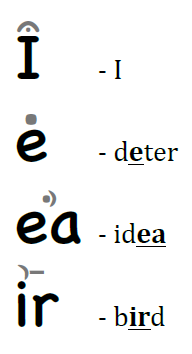
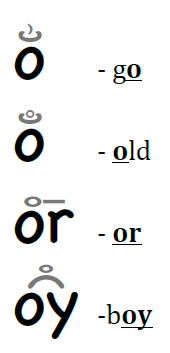
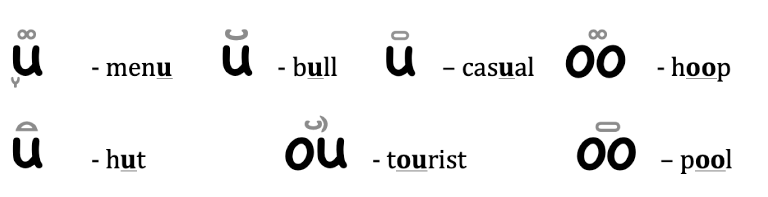
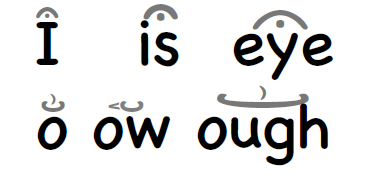
The relationship between spoken English and its transcription is less consistent than any other language. To begin with there are 46 phonemes but only 26 letters. And the multiple ways sounds are represented together with the multiple ways letter-sequences are read produces around 1000 phoneme-grapheme combinations. For Example
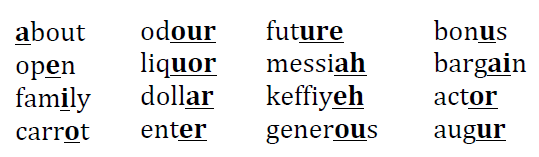
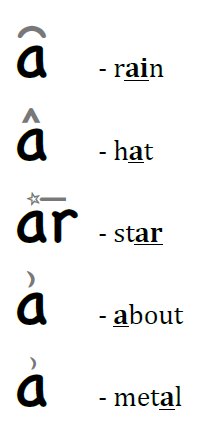
The unstressed vowel sound, know as schwa, can be represented by these letter combinations among others. (Right Insert)
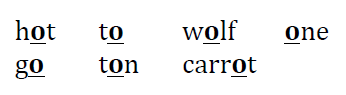
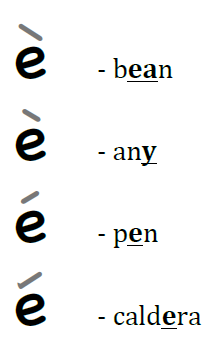
The letter ‘o’ can represent several different sounds, such as in these words. (Left Insert)
Even identically spelled words may be pronounced differently! (e.g. read, dove or wound). This lack of 1:1 sound-symbol correspondence causes great confusion and difficulty when learning to read and spell in the English Language.
Symbophonics eliminates confusion with a system of simple, easy-to-learn, interrelated, mnemonic, phonetic symbols which are superimposed onto text. As the student navigates the complex relationships between spelling and sounds, SPS provides her with a consistent code allowing her to correctly read any English word.
Because Symbophonics is a phonetic system, any accent can be taught by using the appropriate symbols. It is also very flexible in that when teaching young children or those with reading difficulties phonemes with similar sounds can be grouped by one symbol for simplicity.
The symbols used in the examples below correspond to a South-Eastern British accent similar, but not identical to British ‘RP’.
SPS are printed in grey which distinguishes them from the text, affirming them as a temporary aid to students learning to grasp the rules of letter patterns and words, on their way to becoming independent and fluent readers.
In conclusion Symbophonics provides a complete, in-text phonetic decoding/decryption of English.
facilitates the learning process by mnemonic, consistence and logic.
will increase literacy rates towards European levels.
will reduce the average time taken to learn to read to near European levels.
will enable early readers to tackle more difficult and interesting texts
avoids the need for complex and expensive phonics teaching systems
will assist with word pronunciation when looking up new words in dictionaries etc.
will assist in learning foreign languages for which it has been extended
Symbophonics Rules
Definitions
Phoneme
smallest unit of sound considered to be a building block for words.
Grapheme
A letter or sequence of letters representing a phoneme.
Phonics
The relationship between phonemes (spoken sounds) and graphemes (the letters used to represent these sounds)
Consonant
Speech sound made when the breath is obstructed by parts of the oral cavity such as lips, teeth, tongue or palate making contact with each other. E.g. b in bird, th in thing
Vowel
Speech sound shaped by relatively open mouth, in which air flows freely through from the vocal cords without obstruction. E.g. a in hat, ea in break
Vowel Cluster
Two or more letters producing a vowel sound in a single syllable. eg. ough in brought
Consonant Cluster
Two or more letters next to each other producing one or more consonant sounds in a single syllable. E.g. gn in gnome, str in string
Diphthong
A single syllable of 2 vowel sounds that starts with one vowel and moves to another. E.g. oy in boy, ou in house
Digraph
A pair of letters that represent a single speech sound. E.g. th in think or ea in beat.
Schwa
An unstressed weak vowel sound eg. o in carrot, a in petal
SPS
Symbophonics Phonemic Symbol/s – indicate how grapheme is pronounced.
General Consonant Rules
Consonants not marked with SPS hold their regular sound consonant although for beginners SPS can be used wherever they may help reinforce letter to sound association. Unmarked consecutive identical consonants have the same sound as a single one.
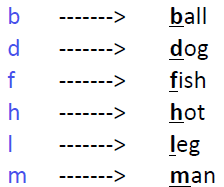
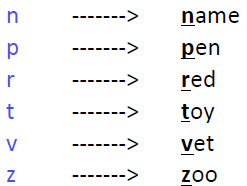
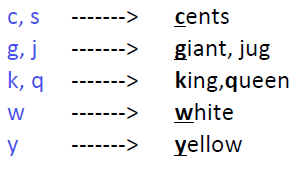
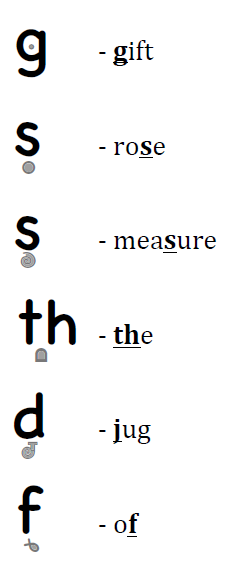
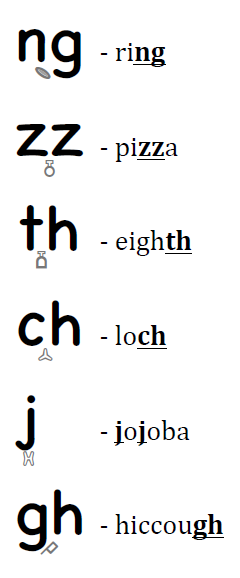
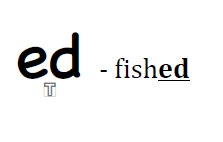
Consonant SPS (except hard ‘c’ [k] & hard ‘g’ [g]) are situated below text (subscript) and denote the phonemic sound a grapheme represents.
Unvoiced
Voiced
Misc
W & Y
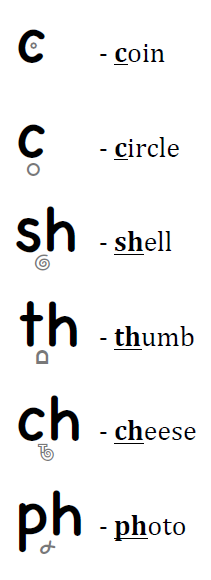
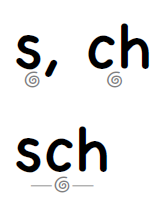
SPS lies directly beneath a single-letter grapheme to denote its pronunciation. For digraphs the SPS lies centred beneath.
For graphemes comprising more than two letters, SPS lie centred beneath the grapheme, with narrow straight lines on either side of the SPS indicating the extent of the grapheme.
On occasion it may lie somewhere non-central in order to best inform of the relationship of the letters to the sound. E.g.
Letters ‘c’ and ‘g’
Unmarked ‘c’ and ‘g’ hold their soft sounds as in the letters’ names. Their SPS, uniquely, lie within the body of the text (intrascript) and act to ‘harden’ the sounds of these letters, providing the ‘k’ sound and the sound of ‘g’ as in ‘get’ respectively. E.g.
Silent Letters in Consonant Clusters
Symbophonics treats so-called ‘silent’ letters as part of a grapheme. The upper vertex of a small triangle points to the letter/s actually pronounced while a narrow line protrudes from its base to denote the extent of the grapheme. E.g.
The Letter ‘x’
Where the letter ‘x’ consists of two sounds for the one grapheme, the first is a hard ‘c’ or ‘g’ and its SPS is placed in the centre-left of the ‘x’. The SPS for the second is placed beneath the ‘x’. E.g.
If the second sound is made by combination of the ‘x’ with the following letter, the SPS lies beneath and between the ‘x’ and the next letter. E.g.
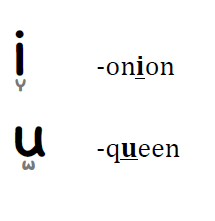
Consonants ending with ‘w’ & ‘y’ Sounds
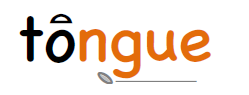
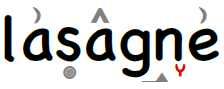
Where a consonant phoneme ends with a ‘w’ or ‘y’ sound (eg. gn in lasagne) this SPS lies to the extreme right under the last letter in the consonant grapheme to indicate it is the last sound of the phoneme. E.g.
General Vowel Rules
Vowel SPS are situated above text (superscript).
SPS lie directly above a single-letter grapheme to denote its pronunciation. For digraphs, the SPS lies centred above. For graphemes comprising more than two letters, the SPS lies centred above the grapheme, with narrow straight lines on either side of the SPS indicating the extent of the grapheme.
Dipthongs
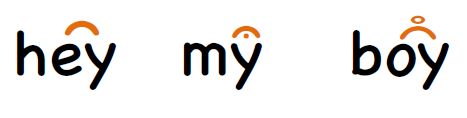
The SPS of dipthongs ending in a ‘u’ as in ‘bull’ sound (ou in house, oa in boat ) or ending in a ‘y’ as in ‘any’ (oy in boy, ay in bay) sound, extend to indicate the entire grapheme.
SPS of dipthongs which share the same last sound also share the same (main) extendable part. E.g.
Hint of ‘r’ Diphthongs
In some accents the letter ‘r’ is only fully pronounced if followed by a vowel and instead of the ‘r’ sound a schwa is pronounced in its place, producing a dipthong ending with a schwa. The symbols for these dipthongs are made up of both simple vowel sound SPS. touring
E.g. hearing,
touring
Long Vowel Sounds
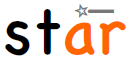
SPS for long vowel sounds are depicted as extensions of short vowel SPS in one of two ways. The first being the use of a thick straight line extending from the short vowel SPS
E.g. ar in star,
or in fork,
er in herd
and the second being an enlargement or extension of the short vowel SPS. E.g.
Magic ‘e’, Bossy ‘e’, Final ‘e’
Where the letter ‘e’ at the end of a syllable appears to elongate the preceding vowel (e.g mat -> mate, bit -> bite), the vowels, separated by consonant(s), are connected by the appropriate vowel SPS. A small indicator triangle beneath the consonant(s) indicates that they should be pronounced at the end of the syllable. If the consonant(s) are marked with SPS, it is these that will indicate that they must be pronounced. E.g.
Further Uses of the Indicator Triangle (IT)
This triangle is used in compound words where an r situated within a vowel grapheme is pronounced because the next syllable begins with a vowel e.g.
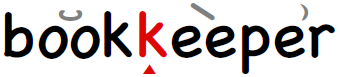
or to indicate a consonant must be pronounced, for instance, when two consecutive identical consonants are pronounced seperately, as in ‘bookkeeper’.
Vowels Beginning with ‘w’ & ‘y’ Consonant Sounds
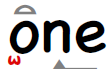
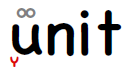
Where vowels represent both consonant and vowel sounds (e.g. u in use, o in one), the consonant SPS lies to the extreme left under the first letter in the vowel grapheme to indicate it is the first sound produced. For Example
(i) o in one represents the ‘w’ consonant sound followed by the ‘u’ as in ‘but’ vowel sound.
(ii) u in unit represents the ‘y’ consonant sound followed by the ‘oo’ as in ‘too’ vowel sound.
Unrepresented Schwas
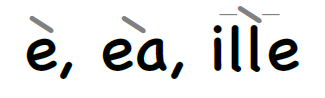
Generally, where ‘le’ occurs at the end of a word and is preceded by a consonant, a shortened schwa is pronounced, even though there is no grapheme representation of this sound. This also occurs before the ‘m’ in words ending ‘ism’.
In such cases, a reduced-size schwa is placed at an elevated level between the consonant graphemes to indicate the schwa is pronounced in addition to the adjacent graphemes. The schwa is elevated in order to distinguish it from a regular schwa SPS, which would indicate the sound of the the letters beneath.
In addition, the presence of any SPS on either of the letters beneath can help identify the schwa as a phoneme independent of the surrounding letters.
Stresses
Symbophonics helps the student become familiar not only with the relationship of sounds of English to the written word but also with how the sounds interrelate. This can help her work out where the stress occurs in a word.
For example, in the word ‘contrast’, pronounced either ‘contrast’ or ‘contrast’, the schwa (always ‘unstressed’) on the ‘o’ in the former indicates the other syllable is stressed. Where required, Symbophonics does offer the possibility of indicating where the stress lies by using darker/lighter shades of grey on stressed/unstressed vowels. E.g.